
A New Dawn: How Acid Detroit shows the Motor City’s Radical Potential for Post-Capitalist Desire
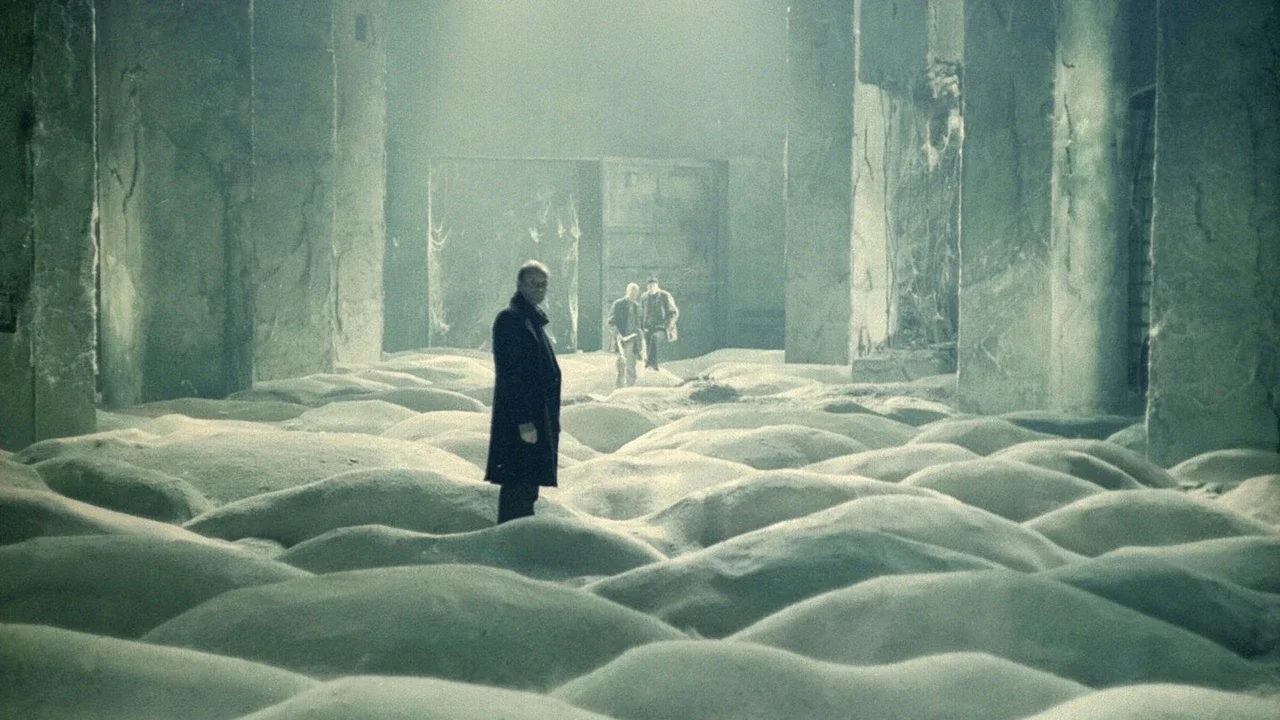
Still from Stalker (1979).
INTRO:
Joe Molloy’s Acid Detroit takes the reader on a journey into the atemporal zone of Detroit, Michigan–a new dimension where time and space meld into a radical history of collectively produced motor city music. This solidarity spans not only from the collective nature of the individuals producing music but to a generational influence that Molloy traces throughout the book. He dismantles popular conceptions and prejudices of the city and imbues it as a beacon of hope for the production of radical art, politics, time, and space. Detroit is a post-industrialist breeding ground for a fusion of radical leftist politics and trail-blazing music that creates the framework for post-capitalist desire.
Acid Detroit is a connection of individual psychedelic shacks that communicate through the fourth dimension, transcending neoliberal formulations of music, culture, race, gender, and class. These feelings of financial security, community, and culture don’t sedate the brain, but expand the capacities of mind… “the fusion of new social movements with a communist project, an unprecedented aestheticization of everyday life,” as Mark Fisher wrote in his unfinished introduction to Acid Communism. Molloy digs deep into the acid-underbelly of Detroit, but he gives the reader the opportunity to dig deeper still. Acid Detroit aestheticizes everyday life, giving the fusion of nature and concrete in Detroit’s abandoned factories and parking lots, meaning that capitalists cannot see (and wish to extinguish). An abandoned factory becomes a space for a collective exploration and experience of music, a rave; an empty parking lot, a space for a community garden in the city; a grimy basement a space for collective rage; music in a bar a space for new revelations and confidence.
Molloy uses Soviet film director Andrei Tarkovksy’s 1979 masterpiece Stalker as a conception for Detroit as a “Zone” of sorts. The Zone in Stalker is a place outside of the film’s controlled space. It is a post-industrialist landscape where decaying tanks and buildings fuse themselves with an overgrown, untouched nature. A space that one needs to go into, to let themself fall into the psychedelic consciousness of the sublime and the transcendental–this is the journey Molloy takes the reader on. “At the core of the Zone lies a room in which a person’s deepest, innermost desires will be granted” (5). This conception of the Zone fuels, for Molloy, a geographic iconography for Detroit which “offers up a similar proposition. Long a symbol of capitalistic neglect, Detroit has been treated as a sort of taboo zone within America, and certainly within the state of Michigan'' (5).
In these haunted ruins is the history of Detroit that Molloy seeks. From the black psychedelia of Motown like the Temptations, Supremes, Marvin Gaye, and Funkadelic, to the Belleville Three and Detroit techno, to proto-punk and hardcore, to the White Stripes and Danny Brown. The production of music in the motor city spawns some of the greatest art the world has seen, extending far beyond the borders of the city and into the aether like a psychedelic miasma that infects everyone.
HISTORICAL BACKground:
Acid Detroit takes a semi-linear history through Detroit music, but understands that history is not produced in a linear fashion. It works like an acid trip. There is a linear time and space, but the mind is free to combine the past with the present, showing us the connectedness of time and space. The Fordist assembly line structured the lives of many working class Black people as Henry Ford wanted the largest labor pool possible to exploit, including that of Berry Gordy Jr., founder of Motown Records. He was inspired by the efficiency of the Fordist production line and wanted to adopt those means of production during the 1950s & 1960s. The pop-cultural modernism of Motown and the likes of the Supremes, the Temptations, and Marvin Gaye put Detroit on the map as a musical breeding ground. However, it also shows how the political economic effects of Fordist production structure everyday life, with Ford claiming “he would never allow his workers to unionize” (9). The United Auto Workers headed by Walter Reuther “organized protests, strikes, and walkouts in the mid-1930s against the ‘Big Three’ automakers.” This militant union action, combined with an increasing class consciousness led to higher wages, benefits, and better working conditions during that time period.
BLACK PSYCHEDELIA:
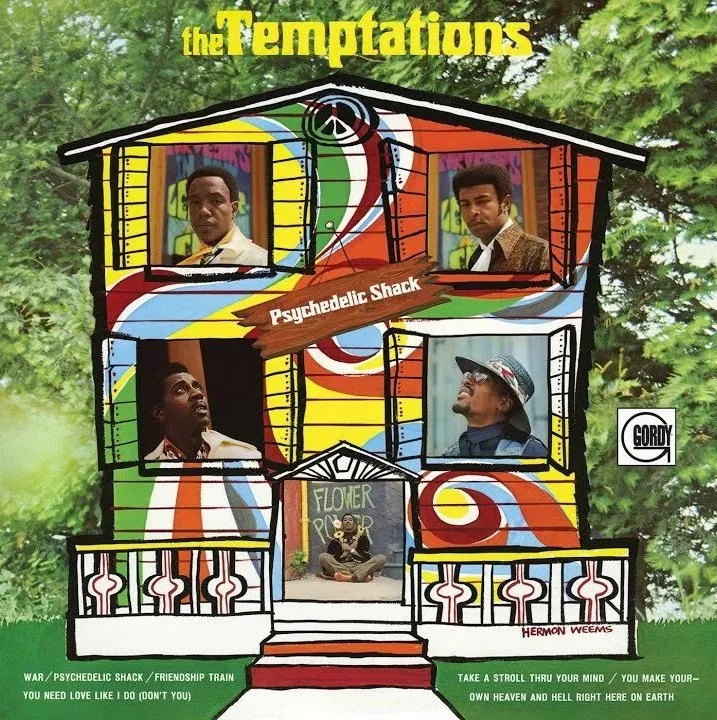
Cover for The Temptations’ Psychedelic Shack.
As the 1960s was coming to an end and unions across the board in the U.S. lost power, a series of proto-punk garage rockers like MC5 and The Stooges formed as an alternative to the Fordist model of production. At the same time, after the 1967 Detroit Rebellion, what Emily Lordi terms “black psychedelia” took over Motown giving us the Temptations “Psychedelic Shack” which is famously at the center of Fisher’s unfinished introduction to Acid Communism. Black Psychedelia rips through Motown beginning with The Supremes, the Temptations, Marvin Gaye, and Funkadelic. In turn, one of Funkadelic’s “biggest influences was MC5, who embedded the Detroit music scene with a commitment to revolutionary ideas,” (62). A common theme emerges from Detroit: political economic circumstances influence music culture while music culture is used to stand in resistance to the political economic structures that loom over Detroit during the neoliberal turn in the 1970s.
NEOLIBERAL ERA:
Detroit’s Death, while only briefly mentioned in the book, exemplifies the acid communist understanding that we were at the boiling point of political revolution during the early 1970s. Their first album (produced by Funkadelic’s producer Don Davis) For the Whole World to See blends psychedelic rock with a proto-punk atmosphere. On “Let The World Turn” they begin in a Funkadelic-like psychedelia that morphs into a proto-punk breakdown. It wavers as a bridge between Detroit’s hardcore punk scene and Motown’s psychedelia. With verses like “If breakthroughs keep occuring/let them in/you know that time is all we’re made of/the world will keep on spinning/let it SPIN/you know that time will all be made up.” Singing over a whammied psychedelic chord, the band dives into the subconscious desire for political revolution. Their reflection on time is both metaphysical and materialist. Acid is able to deconstruct how you experience time and space, forming psychedelic consciousness. Death’s materialist examination of time shows how the capitalist steals time and radical potential from the worker. Time is the resource extracted from human bodies.
HARDCORE AND IMPACT OF NEOLIBERALIZATION:

Still from Lost River (2014).
Molloy’s look into the Hardcore punk scene through Steve Brannon dives into this period of neoliberalization in the 1980s and 90s that swept over the country. Brannon and his various bands especially the long-forgotten but incredible Laughing Hyenas, represent this period where the political no longer feels possible. Materialist time overtaking psychedelic-revolutionary consciousness is a condition examined in Mark Fisher’s book Capitalist Realism. In popular culture and beyond, there is no longer an alternative to capitalism, rather the neoliberal era leads to more precarity and a further sense of loss. “Work and life become inseparable. Capital follows you when you dream. Time ceases to be linear, becomes chaotic, broken down into punctiform divisions” (Fisher 34). The symptom of this condition is Fisher’s idea of “collective depression” where feelings of lost futures, anhedonia, and nihilism reinforce Capital’s perpetual feedback loop of pain, suffering, and nothingness.
In order to have a set of political ideas, you must have hope that things can change, but Laughing Hyenas has no hope, and Molloy’s analysis of their discography and of Brannon’s life show how they have not been able to, in Fisher’s terms, convert their “privatised disaffection into politicised anger”. They represent the conditions of capitalist realism and the decline of future security that Fordism provided in stark terms where “Detroit is haunted by the stain of place and overflowing of time, then it is fitting that Laughing Hyenas’ onslaught begins with the track entitled ‘Stain’” (Molloy 98). At the end of the song Brannon screams “seemingly ad infinitum” the phrase “I’m coming down” harnessing both the power of the drug user coming down from a high, and the body coming out of Fordism and into the timeless space of neoliberalism where extraction reaches its heights.
BROKEN CHRONOLOGY:
Time necessitates a deliberate measurement of change, whether that be numbers on a clock or the heart ticking in your chest. Rhythm in music demarcates a sensible pattern for a song to follow with linearity. Molloy’s voyage into the crates and sample flips of one of Detroit’s favorite sons, J Dilla, reveals the precarious position of our time forced out of joint and his mastery of rhythm in order to understand it. “Straight time” is how music is typically constructed, with steady and uniform moments of change. “Dilla Time” exposes the listener to a sonic world with endless possibilities, where we can move in and out of simultaneous rhythms, play with messy time signatures, and rush or drag through a song with genius precision. “Dilla’s rhythmic strategy is to try and wrongfoot time, throw it off balance and set it moving again, to jolt it out of stasis and back in groove,” (119) showing our broken chronology of lost futures, presenting us clearly with what has been stolen from us by capital.
Dilla’s artistry reminds us of how the ruins of Detroit are being reappropriated. His practice of crate digging and sample flipping almost feels like he is constructing something new from the abandonment of Berry Gordy Jr.’s forgotten Motown factory. Looking at one of the licks off of his Motown tape, we are met with heart pounding, chest thumping distorted production. A rawness that is radiating life. Listening closer, you can hear the familiar sounds of the door creaking open, the sounds of cheers and applause, the desire, welcoming of something new. We can feel the potential in Dilla Time. The collective experience of a moment in the Psychedelic Shack; an effort to understand our past, the hope and projection for a future which has overcome capital.
CONTEMPORARY RESPONSE:
As we travel along the circling vinyl history of Detroit, we must recognize that Capital has yet to reach its peak. Molloy’s exegesis of Danny Brown gives us a finely tuned meditation on the condition of our chronic ‘hedonic-depression’. In his epic Atrocity Exhibition, Brown throttles the listener with an exhaustive heat of delirious hip-hop. A mouthful of MDMA; the rush to feel everything right now. There is no time for even the flashback of a bygone high. Brown becomes “...strung out, hitting the limits of what his body and mind can contain and process, is confronted with his own materiality, the possibility of collapse and death. Rather than a drug-numbed and disembodied Internet avatar, he is in fact suffering flesh and blood,” (144). Brown’s music triggers capitalist realism’s trap of gluttonous politics as consumption, not politics as a radical force for change.
Fisher understood the libidinal desires that pushed technological development. These are tools meant for fulfilling our wishes, there is nothing inherently evil in them. The great wish of a Psychedelic Shack can be felt echoing through the Internet; a place of community and connectedness. Market demands and nauseating forced-hand consumerism has fractured that ideal, rocked the cart until it’s fallen off the tracks. We can take Paul Virilio’s idea of “polar inertia” to better feel the mind numbing acceleration of modernity. Succumbing to the instant present, the haptic feedback of faster than light communication, illustrates how capitalism flattens cultural time, imprisoning us in the forever now. Brown takes us deep into this flattened time, where we are left as dead eyed, digital zombies looking at ourselves in the Exhibition.
Danny Brown’s follow-up record, uknowhatimsaying¿ invites the listener to seek the alternative, to envision a post-capitalist future,“When Brown asks on ‘When It Rain’ Ain’t no water, how a flower gon’ grow?’ he is wishing for rain so that, in the barren desert of depression, the flowers can begin to bloom again. But most of all, the movement from the tortured darkness of Atrocity Exhibition to the light of ethereality of uknowhatimsaying¿ Yet again drives home the point that Detroiters, like Detroit itself, will always adapt and persevere.” (150)

Still from Danny Brown’s Best Life music video.
POST-CAPITALIST DESIRE:
Detroit’s extensive history of industry and labor movements, as well as its ongoing battle against economic decline and abandonment has made the city a breeding ground of solidarity and resistance. Much like Molloy’s conception of Detroit hardcore and Laughing Hyenas as a way to use “time and space communally heal the wounds of a damaged life” (108) post-capitalist desire functions in the same way, where community and cultural production are used to steal time and space back from neoliberal capitalism to fuel our bodies and minds with the consciousness that can only be found in the Psychedelic Shack.
If you’re waiting for spontaneous revolution to come, if you’re waiting to understand post-capitalist desire, if you’re waiting for a sense of solidarity and community–stop waiting, because it’s already here. Look no farther than Detroit, but then look again, at your own city, at your own space, at your own community. If plants can grow through the cracks of the post-industrialist landscape so can we with our movements, community, culture, art and solidarity that are filled with the spores of post-capitalist desire and acid communism ready to be released upon the world.